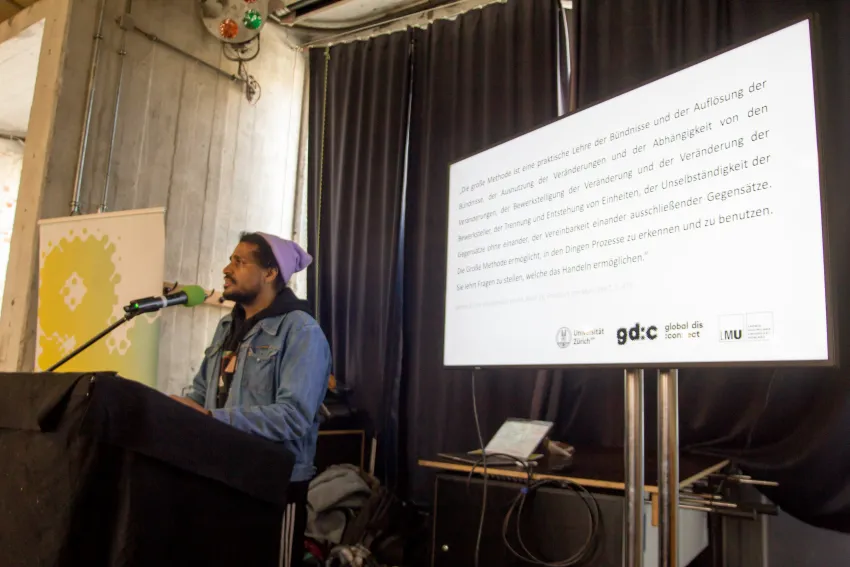
The great method is a practical teaching of alliances and the dissolution of alliances, the utilization of change and dependence on change, the bringing about of change and the changing of the bringers of change, the separation and emergence of units, the independence of opposites without each other, the compatibility of mutually exclusive opposites. The great method makes it possible to recognize and use processes in things. It teaches us to ask questions that enable us to act.
Bertolt Brecht: Gesammelte Werke, Volume 12, Frankfurt am Main 1967, p. 475
In Bertolt Brecht's work, "The Great Method" was mostly read as a cipher for Marxist dialectics. But viewed from the present day, his thinking is more reminiscent of innovators such as Antonio Gramsci or Stuart Hall than Hegel.
For Brecht, "The Great Method" is not a Marxist law of nature or philosophy of progress, but a "practical teaching": a tool for achieving the ability to act under constantly changing conditions. Brecht's program thus appears as "without guarantees" or "without warranties" and as a methodological challenge: curatorial, artistic, scientific, practical, political.
For the Brecht Festival under Julian Warner's artistic direction, this has meant from day one: when society changes, festival visitors and their traditional stories and customs become more diverse, technological means develop and material conditions change, the understanding of theater inevitably changes.
The festival and audience took this insight into account when a parade carried the Brecht carpet from the Golden Hall across the Ulrichsbrücke to Lechhausen, local politics was turned into a wrestling match in the wedding hall of the Alevi community and the former Lederle furniture store on Langenmantelstraße was transformed into a power club. What does it mean curatorially, culturally and politically to act according to the motto "Brecht without guarantees"?
Conference schedule
Friday, 21.2.2025
13.00 - 13.15 - INTRODUCTION by Moritz Ege and Julian Warner
13.15 - 14.45 - KEYNOTE by Alex Demirović (Moderation: Olga Reznikova)
15.15 - 16.45 - BRECHT OHNE DIALEKTIK with Alexander Gallas & Michael Hirsch (moderator: Julian Warner)
16.45 - 17.45 - DINNER
afterwards: joint visit to the festival opening and the wrestling spectacle "Kampf um die Stadt" at Brecht's Kraftklub. (tickets required)
Saturday, 22.2.2025
10.15 - 11.45 - BRECHT OHNE PARTEI with Manuela Bojadžijev & Raul Zelik (moderator: Lisa Riedner)
12.15 - 13.45 - BRECHT OHNE BRECHT with Silke van Dyk & Julian Warner (moderator: Moritz Ege)
13.45-14.45 - LUNCH
15.00-16.30 - OPEN DISCUSSION
afterwards: joint visit to the opera "Rise and Fall of the City of Mahagonny" or the Brecht Night. (tickets required)
13.00 - 13.15 - INTRODUCTION by Moritz Ege and Julian Warner
13.15 - 14.45 - KEYNOTE by Alex Demirović (Moderation: Olga Reznikova)
15.15 - 16.45 - BRECHT OHNE DIALEKTIK with Alexander Gallas & Michael Hirsch (moderator: Julian Warner)
16.45 - 17.45 - DINNER
afterwards: joint visit to the festival opening and the wrestling spectacle "Kampf um die Stadt" at Brecht's Kraftklub. (tickets required)
Saturday, 22.2.2025
10.15 - 11.45 - BRECHT OHNE PARTEI with Manuela Bojadžijev & Raul Zelik (moderator: Lisa Riedner)
12.15 - 13.45 - BRECHT OHNE BRECHT with Silke van Dyk & Julian Warner (moderator: Moritz Ege)
13.45-14.45 - LUNCH
15.00-16.30 - OPEN DISCUSSION
afterwards: joint visit to the opera "Rise and Fall of the City of Mahagonny" or the Brecht Night. (tickets required)
In cooperation with the Käte Hamburger Kolleg global dis:connect of the Ludwig-Maximilians-University Munich and the Institute for Social Anthropology and Empirical Cultural Research (ISEK) of the University of Zurich.
Concept & organization: Julian Warner (festival curator) & Moritz Ege (Professor of Popular Cultures / Empirical Cultural Studies with a Focus on Everyday Cultures)
Photos: Julian Ertelt

With:
Café door to door